Original graphic course · 36 lessons

Investing 101

The lesson order follows the public playlist Claytrader's Trading 101 by Francis RV. The explanations and drawings are original. They are not a transcript, and they are not a recommendation to buy or sell any security. You can lose money.

Start before you size up

01 · How to Get Started Trading

Start before you size up

Getting started is not finding a ticker. Decide whether you are investing money you can leave alone, or trading money you can afford to lose. Build an emergency fund first. Then learn how orders, fees, and taxes work in your country. Open an account only after you can explain how you will lose money, not just how you hope to make it. Start smaller than your confidence.
How a buy order works

02 · How to Buy Stocks

How a buy order works

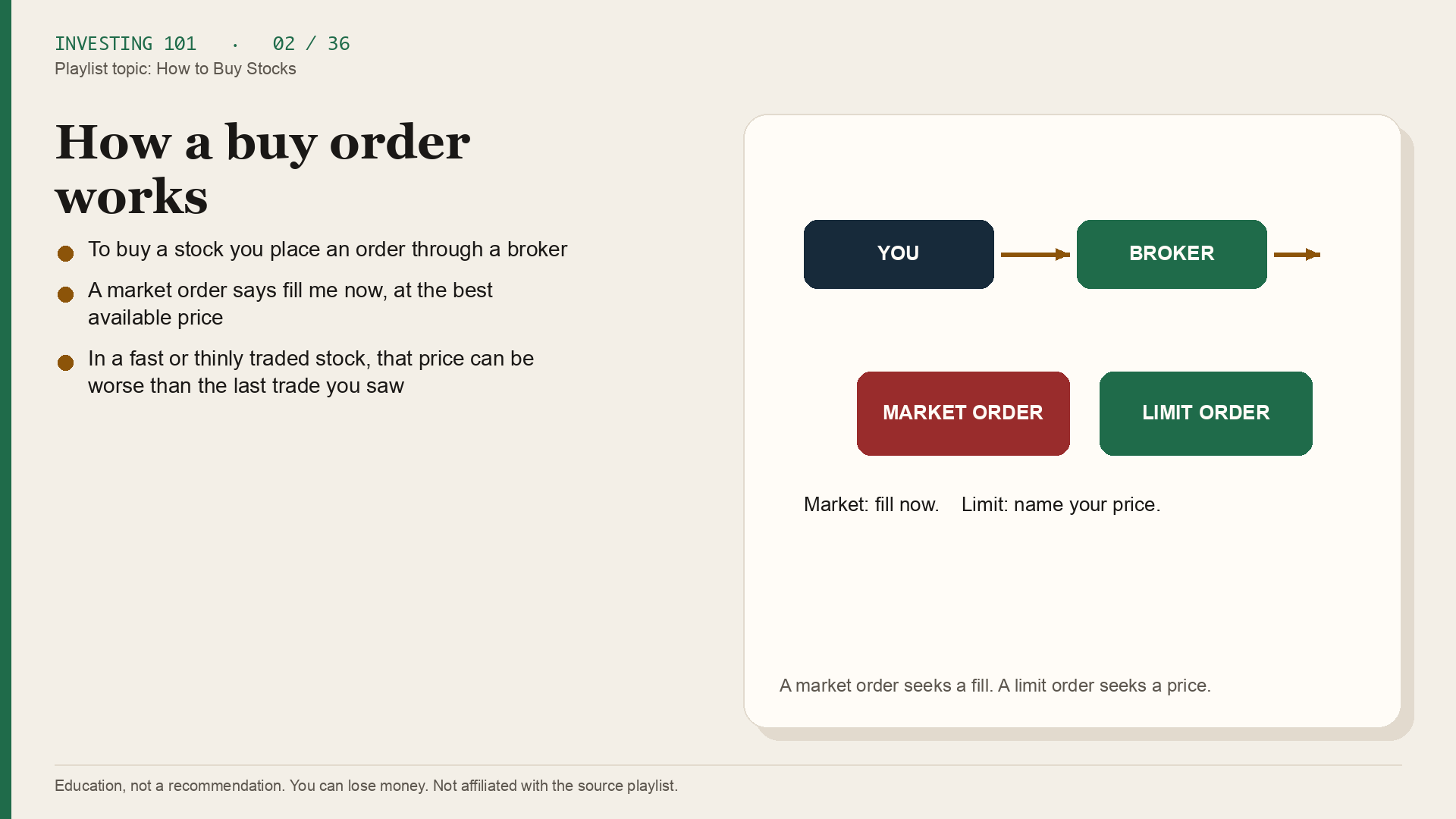
To buy a stock you place an order through a broker. A market order says fill me now, at the best available price. In a fast or thinly traded stock, that price can be worse than the last trade you saw. A limit order names the most you will pay. It protects the price, but it may not fill. You own the shares after the trade is executed. In the United States, stock trades generally settle on the next business day. Confirm the rule for your market and product.

What the stock market is

03 · What is the Stock Market?

What the stock market is

The stock market is the network of exchanges, alternative venues, and brokers where shares are quoted and traded. It is not one building, and it is not the company itself. A listed company has shares outstanding. Investors trade those shares with each other. Prices are public so strangers can agree without negotiating from scratch. The market does not owe you a profit. It offers a price.

What a day trade is

04 · What is a Day Trade?

What a day trade is

A day trade opens and closes a position in the same security on the same day. Buy in the morning and sell before the close, or short and cover the same day. That is different from an investment you intend to hold through quarters and years. In a United States margin account, repeating day trades can flag you as a pattern day trader, which has long carried a twenty five thousand dollar minimum equity rule. Rules change. Ask your broker before you rely on a number.

Trading is not investing

05 · Trading vs. Investing

Trading is not investing

Both traders and investors can buy the same stock. The job is different. An investor is paid, if at all, for owning a business through time: earnings, dividends, and what a buyer will pay later. A trader is paid, if at all, for being right about a shorter price move, after costs. Trading demands more decisions, more costs, and a harsher base rate. Investing still loses money when businesses or multiples disappoint. Pick the job on purpose.

Two ways a stock pays you

06 · How Does a Stock Make You Money?

Two ways a stock pays you

A stock can make you money in two ordinary ways. You sell it later for more than your cost, after fees. Or the company pays a dividend while you hold it. Some stocks never pay a dividend. Some fall so far that years of dividends do not repair the price. Total return is price change plus cash distributions, minus costs and taxes. A rising chart in the past is not a contract.

Most frequent traders lose

07 · The 90% Failure Rate Explained

Most frequent traders lose

You will hear that about ninety percent of traders fail. Treat that as a warning label, not a measured constant. Published studies of day traders, including well known work on Taiwan and Brazil, find that most people who day trade lose money, and the persistent minority is small. Costs, overtrading, and leverage do the damage. The useful lesson is the base rate. If your plan assumes you are the exception, write down why, before you fund it.

Shorting means sell first

08 · What is Shorting / Going Short

Shorting means sell first

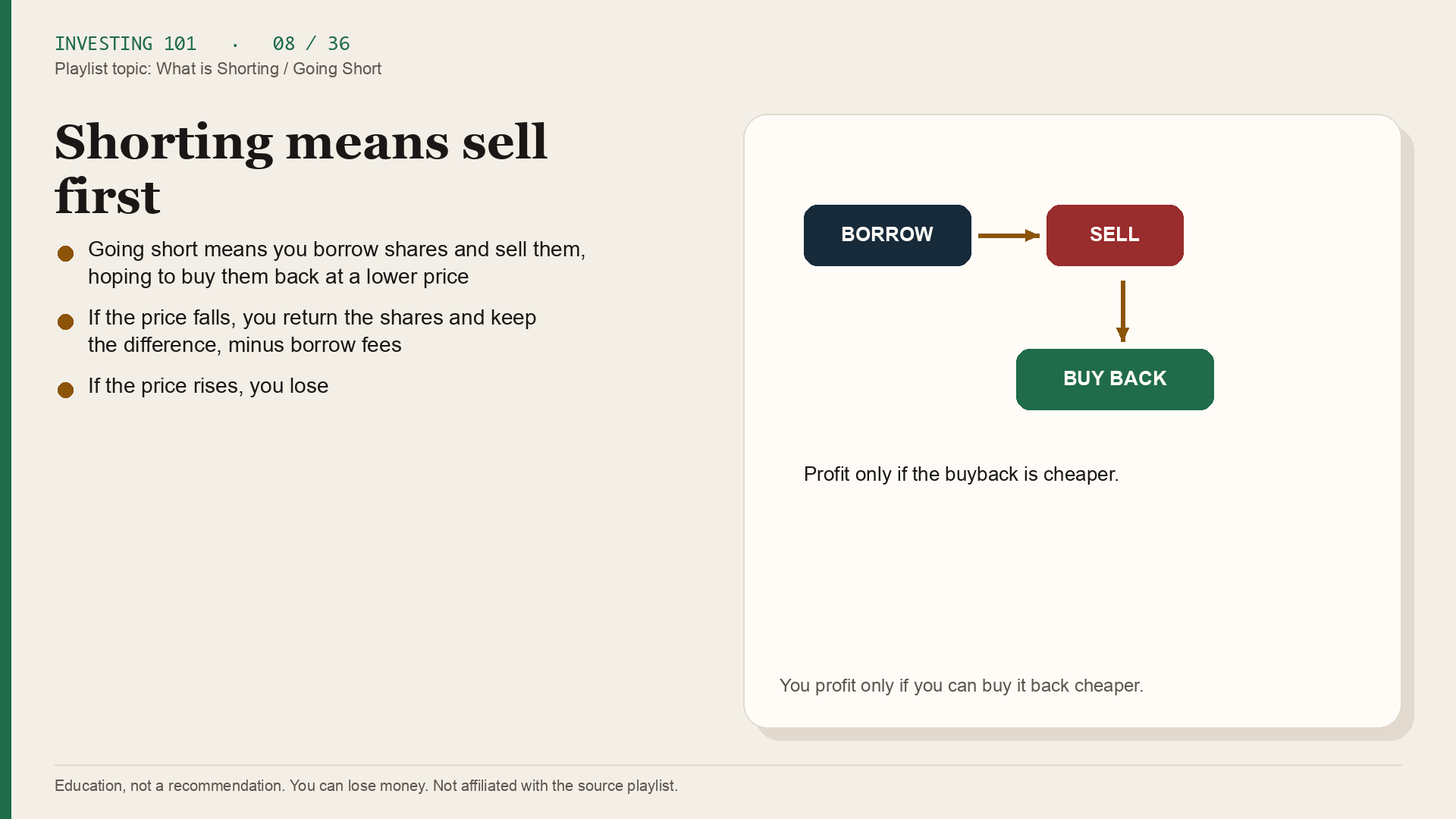
Going short means you borrow shares and sell them, hoping to buy them back at a lower price. If the price falls, you return the shares and keep the difference, minus borrow fees. If the price rises, you lose. The loss is not capped at what you posted, because a price can keep rising. The lender can demand the shares back. Shorting is a credit and timing problem, not just a bearish opinion.

How the market actually clears

09 · How Does the Stock Market Work?

How the market actually clears

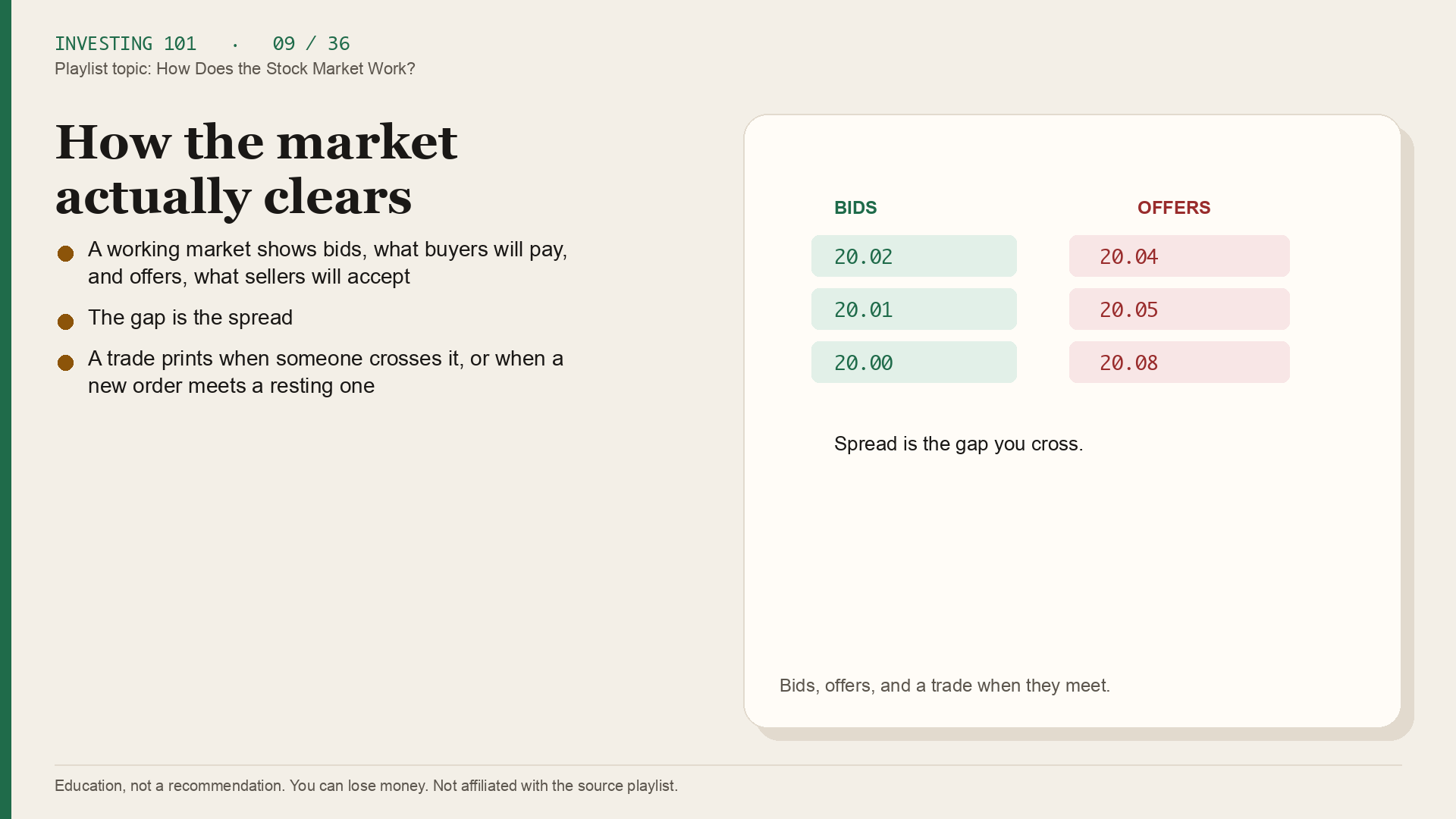
A working market shows bids, what buyers will pay, and offers, what sellers will accept. The gap is the spread. A trade prints when someone crosses it, or when a new order meets a resting one. Brokers route orders. Exchanges and market makers provide quotes. None of that guarantees a fair outcome for you. It guarantees a mechanism: price is where the next willing buyer and seller agree.

Bullish and bearish

10 · What is Bullish / Bearish

Bullish and bearish

Bullish means you expect the price, or the market, to rise. Bearish means you expect it to fall. You can be bullish on a company and bearish on the index, or bullish long term and bearish this week. The words describe a position, not a tribe. A thesis needs a reason and an exit. Calling yourself a bull does not move the order book.

A dividend is not free money

11 · What is a Dividend?

A dividend is not free money

A dividend is cash the board chooses to pay shareholders from the company's resources. On the ex-dividend date, the share price typically drops by about the dividend, all else equal, because the cash is no longer inside the company. You are not wealthier just because a dividend was declared. Dividends can be cut. Tax treatment depends on your country. Read the date, the amount, and the policy. Do not chase a yield you do not understand.

Opening an account

12 · How to Open a Trading Account

Opening an account

A broker will ask who you are, where you live, and how you will fund the account. That is regulation, not trivia. Choose a cash account or a margin account on purpose. Margin can borrow. It can also force a sale. Check what the account is allowed to trade, how withdrawals work, and what happens if the broker fails. In the United States, SIPC protects against broker failure up to statutory limits. It does not protect you from a falling stock.

How a stock loses you money

13 · How a Stock Can Lose You Money

How a stock loses you money

You lose money when you sell below your cost, or when the position is worth less and you still hold it. An unrealized loss is already a smaller account, even if you have not clicked sell. You also lose through fees, a wide spread, taxes on a gain that later reverses, and the opportunity you did not take. Leverage and options can lose more than a simple share purchase. The chart does not have to go to zero to hurt.

What a day trader is

14 · What is a Day Trader?

What a day trader is

A day trader's plan is to end the day flat, or nearly flat, and to extract profit from intraday moves. That requires screens, rules, and the ability to stop. It is not a salary. Many people who call themselves day traders are undercapitalized and overactive. If you want the label, define the setup, the risk per trade, and the condition that makes you stop for the day. Without those, you are clicking.

Margin is a loan

15 · What is a Margin Account?

Margin is a loan

A margin account lets the broker lend you money against your securities. That increases buying power and increases losses by the same ratio. You pay interest. If the equity in the account falls below the maintenance requirement, the broker can issue a margin call and sell positions, sometimes without waiting for a convenient price. Margin is useful for some short sales and for settlement. It is a poor way to turn a hunch into a larger hunch.

Nobody can quote your weekly paycheck

16 · How Much Money Will You Make per Week?

Nobody can quote your weekly paycheck

No honest teacher can tell you what you will make per week. A market return is uncertain. A trading return is more uncertain, and after costs the average active result is poor. If someone promises a weekly income from day trading, they are selling a feeling. Size positions so a bad month is survivable. Do not spend paper gains. Do not replace rent money with a forecast.

Becoming a day trader

17 · How to Become a Day Trader

Becoming a day trader

Becoming a day trader is operational, not mystical. You need a funded account, a broker that allows the style, a market you understand, and risk limits you will obey when you are wrong. In the United States, pattern day trading rules can block the style in a small margin account. You also need a record of paper or tiny live trades that shows you followed the plan. A course, including this one, does not make you profitable.

Why the broker exists

18 · How Online Brokers Work

Why the broker exists

An online broker holds your cash and securities, shows you quotes, and sends your orders into the market. You generally cannot walk onto an exchange and trade as a retail person by yourself. The broker is paid somehow: commissions, interest on cash, margin interest, payment for order flow, or a mix. That payment can affect where your order goes. Custody is the service. Alignment with your profit is not guaranteed.

Hindsight is a liar

19 · Be Aware of Hindsight

Hindsight is a liar

After a stock doubles, the reason feels obvious. Before the move, that reason was one story among many. Hindsight bias makes you overtrust the next story. The antidote is a journal written before the outcome: what you bought, why, what would prove you wrong, and what you will do then. If you only review winners, you are studying a highlight reel. Review the trades you skipped and the ones you refused to exit.

Are you up or down?

20 · Am I Making or Losing Money on this Stock?

Are you up or down?

Your gain or loss starts at cost basis: what you paid, including commissions if any, adjusted for splits and some corporate actions. Market value minus that cost is unrealized profit or loss. It becomes realized when you sell. A stock can be up from your purchase and still be a bad result if a simple index did better over the same time. Look at percent, dollars, and time. A ten percent gain in a day and a ten percent gain in five years are not the same outcome.

What moves the price directly

21 · What Directly Affects a Stock’s Price?

What moves the price directly

A headline does not push a price by magic. The price changes when buy and sell orders change. If bad news makes holders sell and buyers step away, the next trades print lower. If nobody trades, the last price can sit there while the news is already old. Supply and demand for the shares, right now, is the direct cause. Earnings, rates, and rumors matter because they change who is willing to cross the spread.

A checklist, not a secret sheet

22 · Trading Cheat Sheets

A checklist, not a secret sheet

A useful cheat sheet is a pre-trade checklist you wrote yourself. What is the thesis in one sentence. What price or fact proves it wrong. How many shares, and what percent of the account is that. What does the round trip cost. When will you stop for the day. Patterns and indicators can be on the list only if you have tested how you behave when they fail. Someone else's sheet is their process, not your edge.

There is no universal best stock

23 · The Best Stocks to Buy

There is no universal best stock

There is no list of best stocks that fits every person. A stock can be a fine business and a bad purchase at the wrong price, in the wrong size, with money you need next month. Liquidity matters, because you have to be able to exit. Costs matter. Understanding the business matters more than a slogan. If you cannot explain how the company makes cash, you do not have a thesis. You have a ticker.

The arithmetic of a short

24 · The Math of Shorting

The arithmetic of a short

Suppose you short one hundred shares at twenty dollars. You receive two thousand dollars, and you owe the shares. If you cover at fifteen, you buy them for fifteen hundred and the difference is your gross profit, before borrow fees. If the stock goes to forty, you need four thousand dollars to cover, and you are down two thousand, plus fees. A stock can more than double. Zero is the floor for the price, so the short's profit has a ceiling. The loss does not.

The real cost of a trade

25 · Online Broker Fees Explained

The real cost of a trade

A zero commission stock trade can still cost you the spread, a poor fill, margin interest, wire fees, options contract fees, and small regulatory fees. Payment for order flow can make the commission zero while the execution is the product being sold. Compare brokers on the all-in cost of the way you actually trade, not on the headline. Frequent trading turns a tiny cost into the strategy.

How much money you need

26 · How Much Money Do I Need To Trade?

How much money you need

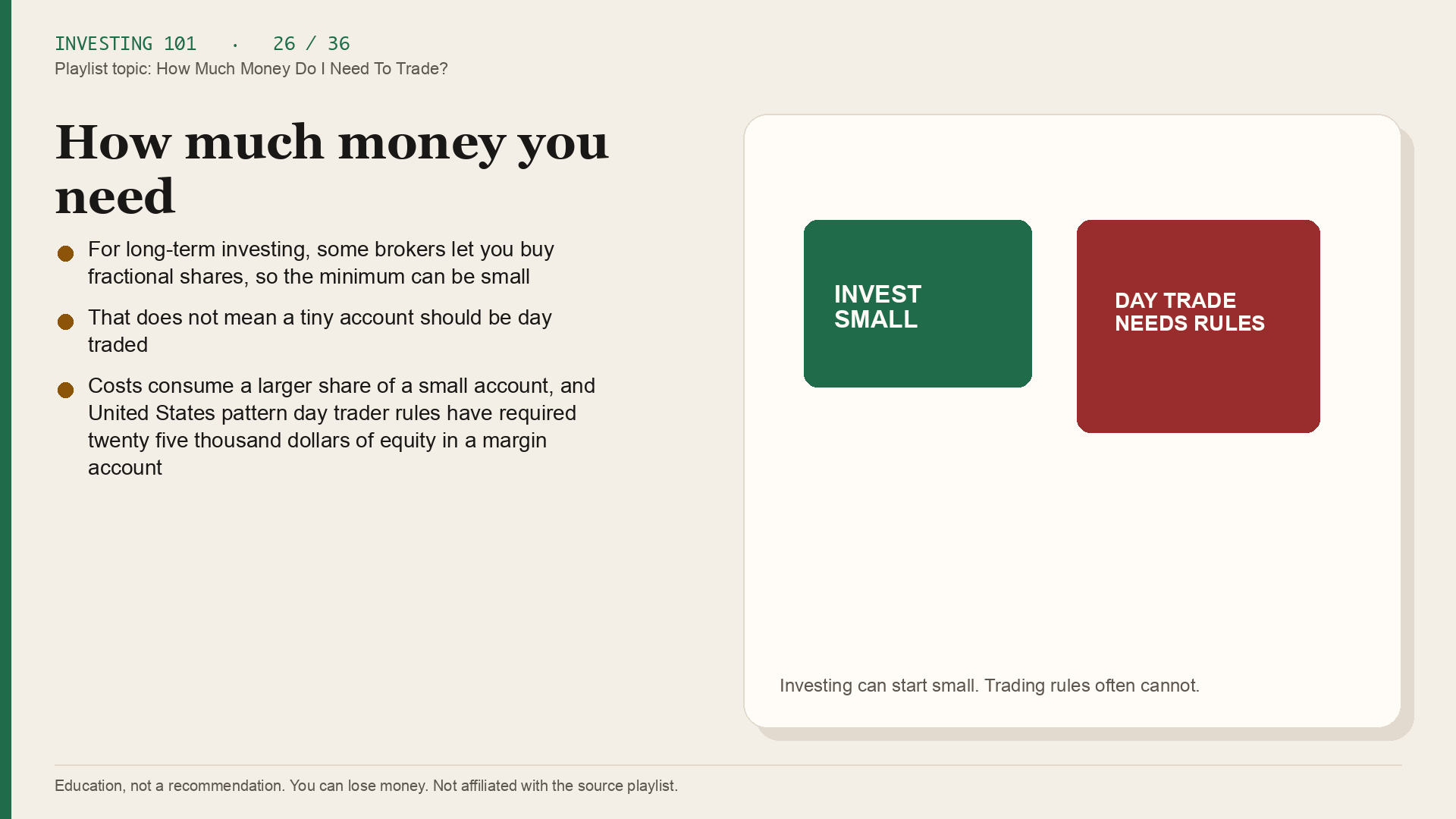
For long-term investing, some brokers let you buy fractional shares, so the minimum can be small. That does not mean a tiny account should be day traded. Costs consume a larger share of a small account, and United States pattern day trader rules have required twenty five thousand dollars of equity in a margin account. Options add contract minimums. Never put in rent, food, or emergency money. If the account cannot survive a dull year, it is too large relative to your life, even if the broker accepts it.

What a mutual fund is

27 · What is a Mutual Fund?

What a mutual fund is

A mutual fund pools money and holds a portfolio. You own shares of the fund, not a direct pile of the underlying stocks in your name. Traditional mutual funds are priced once a day at net asset value. An exchange traded fund, by contrast, trades all day like a stock. The expense ratio is a permanent drag. A fund can be broad and cheap, or narrow and expensive. The label mutual fund is not a risk rating.

Who is talking, and why

28 · Who is Your Source?

Who is talking, and why

Before you act on a tip, ask how the speaker gets paid if you believe them. A teacher, a broker, a fund manager, a friend, and a stranger on video have different incentives. Some are paid when you trade more. Some are paid when you buy a course. Some are sincere and still wrong. This explainer is not a signal. A source that will not discuss how they can be wrong is a salesperson.

Choosing a broker

29 · How to Choose a Broker

Choosing a broker

Choose a broker you can explain. What can you trade. What does a round trip cost. How fast can you withdraw. What protection exists if the firm fails. Are the tools good enough that you will not pay a second platform for the same job. A fancy interface is not execution quality. Read the margin agreement before you need it. If you do not understand the fee page, you are not ready to fund the account.

Diversification

30 · How to Diversify Stocks

Diversification

Diversification means your result does not depend on one company, one sector, or one story. It reduces the risk that is unique to a single holding. It does not remove market risk. In a crash, correlations often rise and the protection shrinks. Owning twenty nearly identical stocks is not diversification. A broad, low-cost fund is one way to get it without pretending you can analyze fifty businesses. Concentration can win. It can also end the game.

What a stock is

31 · What is a Stock?

What a stock is

A share of common stock is a slice of ownership in a company. You are not lending the company money. That would be a bond. Shareholders have a residual claim: after employees, suppliers, and lenders are paid, what remains belongs to the owners. Some shares vote. Some companies pay dividends. The market price is what another investor will pay today, which can be far from the value of the business. Price and value are related. They are not the same number.

A degree is not the ticket

32 · College Degree Needed for Trading?

A degree is not the ticket

You do not need a college degree to open a brokerage account or to buy a stock. A degree also does not give you a right to a trading profit. What helps is literacy: reading a statement, understanding a fee, and knowing the difference between a company and its stock price. That can be learned outside a campus. Formal study of accounting, statistics, or history can make you harder to fool. It still will not tell you next week's price.

How a price gets printed

33 · How is a Stock's Price Determined?

How a price gets printed

The price you see is usually the last trade, sitting between the best bid and the best offer. It was determined when a buyer and a seller agreed, often by one of them accepting the other's quoted price. Add a large buy order and the next prints can walk up the book. Add sellers and they walk down. Analysts, models, and narratives influence who shows up. The print itself is still an agreement between orders. There is no official correct price waiting offstage.

Buying online, without the folklore

34 · How to Buy Stocks Online

Buying online, without the folklore

The online path is plain. Fund the account. Search the symbol and confirm it is the company you mean. Choose buy, the number of shares or the dollar amount, and market or limit. Read the estimated cost. Submit, then check that the fill matches what you asked for. Screenshot the confirmation. Do not buy because a button is green. Do not average down just because the screen turned red. The interface is designed to be fast. Your job is to be slow enough to understand the order.

When the company actually gets the money

35 · How a Company Benefits from the Stock Market

When the company actually gets the money

When investors trade existing shares with each other, the company does not receive that cash. The company receives money when it issues new shares, as in an initial public offering or a later sale of stock. A higher trading price can still help. It makes the next issuance cheaper, supports employee equity, and can be used as currency in a deal. A falling price does the reverse. Secondary trading is mostly a conversation among owners, not a deposit into the company till.

A reverse split does not create value

36 · What is a Reverse Split?

A reverse split does not create value

In a one for ten reverse split, one thousand shares at fifty cents become one hundred shares at five dollars, before the market reacts. The company's market value is unchanged by the arithmetic. Companies often do this to lift a price above an exchange's minimum. It can be a sign of distress. It can also be administrative. The split itself is not a gift and not a theft. Read what changed in the share count, and ignore anyone who treats the new price sticker as a rally.